
 by development.emi
 No Comments

Key Takeaways
- Repetition is normal and developmentally healthy for children aged two to five; familiarity makes them feel safe and in control.
- Rewatching is active learning, not passive viewing. Each replay teaches a new layer of vocabulary, patterns, and cause and effect.
- The same repeat-until-it-sticks mechanism drives personality development for kids, which is why what they rewatch matters so much.
- Never stop it cold. Use gentle limits, similar content, conversation, and protected offline play to widen the child’s world gradually.
- Think of it as children character vaccination: small, repeated doses of good values build lasting inner strength.
- Aim for balance, not elimination. The screen should be one part of the day, not the shape of it.
If your two-year-old has watched the same cartoon like forty times this week and then just asks for it again the second it finishes, you aren’t alone. Almost every parent with a little one goes through this phase, honestly. It can feel pretty maddening, and sure, maybe even a bit worrying. Still, that little loop your child keeps replaying is not just noise; there is real work happening under the hood while you are busy thinking about it.
The Brain Behind the Behaviour
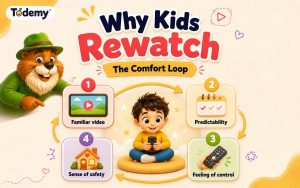
Between the ages of two and five, children are sort of building the mental scaffolding for how the world works. Adults crave novelty, while small children… seem to want the opposite , and it feels like. Familiarity is how they feel safe and safety is the ground they stand on before they go anywhere new, or even try to look at it.
When a child already knows what happens next in a video, that predictability hands them something they rarely get to feel, which is sort of control. They know the song is coming.They know the character will fall down. They know how it ends. And in a world where almost everything is decided by grown ups, being the one who knows what happens next is quietly powerful, in a way that’s easy to miss.
Think about how young children act at bedtime, or with a favourite blanket, or when they insist on the same story every single night. That repeated video belongs to the same family of behaviours. It’s like a small, portable island of certainty in a day that’s otherwise full of surprises they did not choose, and cannot really predict.
Repetition Is How Learning Sticks
Repetition isn’t a bug in early childhood. It is sort of the main thing. Every time a child re watches, they aren’t only “just” enjoying the story, they are soaking up new layers, even if it looks the same. The first viewing maybe is all about the colours and the sound. The fifth is more about the words. The fifteenth tends to be about the chain of events, and how one thing nudges into the next.
That’s also how young children learn vocabulary, find patterns, notice cause and effect, and even social behaviour, in a very natural way. A word heard once kind of drifts by. A word heard thirty times becomes part of them. Educational researchers have been saying for ages that repeated exposure is one of the strongest motors behind language acquisition in the early years. So when your child is rewinding the same clip, they are really running their own quiet little research session.
There is a specific, satisfying moment many parents know well: the child who has watched a clip dozens of times suddenly says the line a half second before the character. That isn’t boredom. That is mastery. They moved from simply watching the story to holding it, and holding something is one of the most confidence building experiences a small child can have.
When Repetition Stays Healthy
For most families, this phase is pretty normal, and honestly even kind of helpful, like its not some big dramatic thing or anything. Healthy repetition usually comes out like this, the child watches, then happily drifts back into play, meals, or people again. They can get rerouted without a full on meltdown. The video is just one small bit of their day not the entire shape of it, you know? They take what they watched and fold it into their play, acting out little scenes or repeating the same lines, but in their own way.
A really good sign is when the video sort of leaks out into the rest of their world instead of sealing them away from it. The song turns into something they murmur in the bath. The character becomes a person they pretend to be while they’re in the garden. When a video feeds a child’s imagination, instead of replacing it, the cycle is working for them, not working against them. If this sounds like your child, there is nothing to patch or fix. Just let it run its course.
When It Starts to Signal Something More
The picture changes when the video stops being a little source of joy and starts becoming a source of comfort, something the child can’t do without. Keep an eye on a few shifts, because it can be subtle at first: the same video gets played again and again, many times in a day, and the count just keeps going up. Your child starts getting genuinely upset not only mildly disappointed, when you ask them to do anything else. Screen time begins to crowd out play, moving around, and real contact with people. Also the video is brought in to hush every difficult feeling, so the child never really practices other methods to calm themselves down.
None of these by itself is some kind of alarm bell. Every child has clingy days, tired days, unwell days when the same clip repeats on and on, and honestly that’s completely okay. What matters is what happens over time. Taken together, and in a steady kind of way, these signals can mean the child is leaning on the screen for regulation, rather than grabbing it for fun. And that’s the moment to gently step in, not to yank anything away right away but to guide things back.
What Parents Can Actually Do
The instinct is often to cut the cord cold, like, just stop it. That usually backfires, because for the child you are taking away a real source of steadiness . A slower tack works a lot better, honestly.
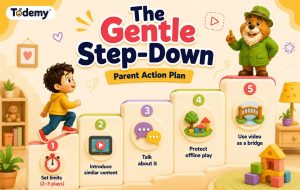
Set soft and steady limits, not a fight. Two or three plays, then something else, every time , no surprises . Predictable rules feel secure to a child in the same way the familiar video does. Bring in content that rhymes with what they already adore. If they really love a video about animals, then offer a book , a toy , or even a game that has those same critters. You are expanding the circle, not breaking the bond.
Also talk about what they watched. Ask what the character tried to do and why . This makes passive watching turn into a conversation , and it deepens the learning, bit by bit. Keep the offline play protected . Build in dependable blocks of screen-free time, especially hands-on physical play and pretend worlds, so those muscles stay growing. Think of video as a bridge , not a wall . Watch together sometimes, then carry the story off-screen and into a game you play right there in the room.
It also helps to label the shift before it even happens. A child who gets a heads up that the video will end after this play, and then gets a reminder halfway through, handles it far better than a child whose screen just, goes dark. You are basically giving them the same comfort the video offers: the sense of what comes next.
If you do it consistently and gently, these steps nudge a child from leaning on the screen toward joining the broader world, without ever making the screen feel like it was snatched away from them.
The Bottom Line
Watching the same video again and again isn’t automatically a bad habit, not really. It feels like a natural, kind of clever piece of how young children learn and also how they calm themselves down. The point isn’t to just squash it, or stamp it out. It’s more about staying in balance, to notice when the comfort starts leaning toward dependence, and to keep softly widening your child’s world so the screen becomes just one small corner of a full, varied day.