
 by development.emi
 No Comments

Key Takeaways
- Screen time’s effect on emotional development is gradual, which is why it is easy to miss. Notice patterns over months, not single days.
- Children learn emotions through responsive, real time interaction with people, something a one way screen cannot provide, which is why social emotional learning for kids depends so much on everyday human moments.
- Screens can quietly become a tool for avoiding feelings rather than processing them, especially when used to calm every hard moment.
- Watch for a growing pattern of less communication, fading interest in play, screen preference, and distress when screens stop.
- The goal is balance, not removal: protect screen free time, talk often, bond in ordinary moments, and offer non screen ways to self soothe. Building emotional intelligence for children does not require a big overhaul, just small consistent choices, and a structured child development program can help make those choices easier to keep up.
Screens are woven into childhood now in a way they never were before, like cartoons, learning apps, video calls with grandparents, or a quick clip to keep a toddler calm in a waiting room. Used well they open doors. Still there’s this quieter question underneath the convenience, while your child is staring at a screen, what are they not doing? And does it matter for how they learn to feel, understand, and manage emotions? This is really a question about social emotional learning for kids, and how much of it happens outside a screen altogether.
Yes, it can matter. The effect is easy to miss because it doesn’t happen all at once; it’s more like small changes stacking up over time.
Why the Change Is Hard to Notice
Emotional development doesn’t really shift over night. A child won’t just go to bed sociable, and wake up withdrawn. Instead small changes keep stacking up, week by week, almost quietly. Like a little less chatter at dinner. Maybe a bit more pushback when it is time to turn the tablet off. Then a slightly shorter fuse when playtime gets interrupted. Each one alone seems like a normal little moment, just another phase, you know. And it is only once you look back, over a few months, that the whole pattern actually shows up, clear-ish.
This slow kind of progress is exactly why screen time should be considered with care rather than pure panic. There isn’t one big dramatic scene to react to. So it helps to build the practice of noticing, gently but often.
How Screens Shape a Child’s Emotional World
Young kids do not just pick up emotions from, like, instructions or neat explanations. They more or less learn them from faces, tone, and all that quick back and forth stuff. When a parent frowns the child kind of studies it, even if nobody says anything. When a friend cries because a toy got snatched, the child feels that heaviness in the moment. And when someone laughs at their joke, they get the message that this bond, connection, it feels good. All those little thousands of tiny real time moments, that’s where a child builds an emotional vocabulary, bit by bit. This is the foundation of emotional intelligence for children, and it is built through people, not programmes on a screen.
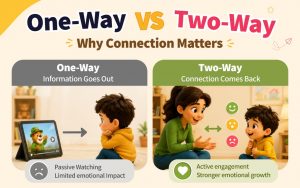
A screen though, even if it seems super engaging, it doesn’t really respond to your child the same way. It doesn’t ease up when they are sad. It doesn’t slow down when they look uncertain. The interaction goes one direction only, not this shared rhythm where both people matter. So once screen time starts taking over human time, instead of just sitting alongside it, children end up missing the practice they need. They miss the chance to notice what they feel, and then to put those feelings into words.
There’s also a second effect, a quieter one. Screens are really good at calming. A child is crying and suddenly goes still the second a favourite video starts. That can be fine, and honestly it’s not wrong to use it sometimes. But if the screen becomes the go to method for every tough feeling, the child doesn’t practise the slower, harder skills of self soothing. They don’t practise waiting, or asking a person for comfort. Little by little, screens can turn into a way to sidestep feelings, instead of moving through them and learning how.
Signs Worth Watching
None of these signs is, by itself, definite proof there’s a real issue. Kids can have mellow days, and also, clinging days. What really matters is a pattern that sort of builds up and keeps going:
Less communication, where your child talks to you less and also shares fewer bits about their day. Interest seems to fade in the usual get togethers, like when they’d rather stay by themselves than join other kids. Screens start to win over almost any social outing, even ones they used to genuinely enjoy. Strong irritation, or even distress, shows up when the screen gets turned off or when something interrupts it. And you may notice fewer of those small emotional asks children usually toss out, like bringing you things, asking questions, or looking for a cuddle when they’re upset.
If you’re seeing several of these at once, and especially if they’re growing, it can be a nudge to re balance things, not a reason to panic.
What Parents Can Actually Do
The aim is never to strip screens out of your child’s life. Screens can genuinely support learning, spark curiosity, and give parents a much needed pause. The goal is balance, so screen time supplements connection instead of quietly replacing it.
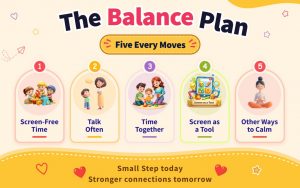
Protect daily screen free time. Try predictable little pockets, like mealtimes, the hour before bed, and stretches of play, and keep them consistent. Children sort of settle into rhythms they can rely on.
Talk, and talk often. Narrate your day, ask about theirs, name feelings out loud. “You look frustrated, that puzzle is tricky.” This everyday kind of commentary is how children gather the words for what they feel.
Spend unhurried time together. Emotional bonding shows up in normal moments, not only in grand events. Reading, cooking, walking, or simply being nearby counts too.
Treat screens like a tool with a purpose. Choose content on purpose, watch some of it together, and then talk about what you saw afterwards. Shared screen time is different, like actually different, from solo screen time.
Offer other routes to calm down. When your child is upset, sometimes go for a cuddle, a quiet corner, or a few deep breaths together instead of a device, so they build a wider set of coping skills.
Small daily interactions build faster than parents expect. A few minutes of real, attentive connection holds more emotional weight than any app. For parents looking for more structure, a good child development program can also give these everyday moments a clearer framework, pairing parent led connection with activities designed around how young children actually learn to feel and cope.
The Bottom Line
Screens are not exactly the enemy of emotional growth, and like, guilt is not what we are chasing here. Still, screens can’t do the one thing kids need most, which is that warm, responsive, live human connection. Attention matters, conversation matters, and that emotional bonding is what helps a child grow into a confident, kind of feeling person. Keep screens in their proper place, as one useful slice of a full, connected day, and then they tend to support that growth instead of getting in its way.