
 by development.emi
 No Comments

Key Takeaways
- Play, not lessons, is how toddlers build brain connections. Between ages two and five, the brain forms connections faster than at any other life stage, and games drive most of that growth.
- Sorting, stacking, pretend play, memory games, music, and outdoor movement each build a different set of skills — spatial reasoning, language, working memory, and emotional regulation.
- The “just right” challenge zone matters. A game that’s too easy or too hard does less for the brain than one with a small, solvable problem.
- Let kids fumble. Stepping in to “help” or correct a game usually removes the exact struggle that builds new connections.
- Child character traits development happens gradually, through small repeated moments, not big one-time lessons — empathy, patience, honesty, resilience, and kindness are the traits that take root earliest.
A steady kids daily routine and discipline structure gives toddlers predictability, which makes both play and character growth easier to stick. - Expensive toys aren’t necessary. Open-ended objects (blocks, boxes, spoons) usually beat single-purpose toys for brain development, and consistency matters more than perfection across all three areas.
Your toddler just spent twenty minutes, putting the same three blocks in a cup, dumping them out, and then doing it again. And again. You might feel like calling it “just playing” … but, it’s not. Honestly it’s one of the most important things happening in your kid’s brain, all day.
Between ages two and five, your child’s brain is building faster than it ever will again. Pathways between neurons form at a wild pace — some researchers even estimate it at over a million new connections per second in those early years. The part that surprises people is this: play is how most of that building gets done. Not flashcards. Not screen time. Play.
So if you’re hunting for brain development games for toddlers, you probably don’t need a strict lesson plan, or some curriculum-ish set, or a subscription box full of “educational” toys. What you need are games. Real ones, the kind that make your kid laugh and, kind of totally, forget they’re “learning” anything at all.
Why Games Work Better Than Lessons
Toddlers do n’t learn the same way adults do. Put a two year old on a chair and try to “teach” them something straight on, and you’ll usually see a blank look, or the kid is already scooted under the table. But give that same child a game—some thing with rules, little surprises, repetition, and just enough difficulty— and suddenly their brain kind of wakes up, you know?
It’s because play flips on several brain systems all at once, attention, memory, problem solving, motor control, emotional regulation, and they cooperate like, right there. A worksheet might poke just one of those areas. A game like hide-and-seek hits all of them, plus it’s enjoyable, and that part matters a lot more than people want to admit. Kids latch onto what they like. They ignore what feels like chores.
There’s also a timing thing. Some abilities show up best in certain windows, for example language, spatial reasoning, and fine motor control. If you miss that moment entirely the skill can still grow later, sure, it’s just more work. If you catch the window using the right kind of playful practice, it often comes almost naturally.
Games That Actually Build Something
Not every game is created equal for brain development. Here are the best brain development games for toddlers, sorted by category, with specific ideas you can start using today.
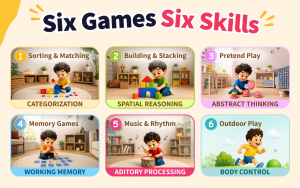
Sorting and matching games
This sounds kinda dull on paper and yet in real life it stays… weirdly never dull. Like, give a toddler a pile of mixed things, buttons, blocks, little plastic creatures, or whatever’s around, and ask them to sort by color size or type. That helps categorization in the brain, which is like a groundwork for the more logical thinking stuff later on, you know.
Try this instead: dump a laundry basket of socks on the floor, then make a race out of finding matching pairs. It’s basically a household task wearing a game mask, and toddlers usually don’t even register the difference.
Building and stacking
Blocks, cups, pillows, whatever else stacks, really. In building games you start developing spatial reasoning and hand eye coordination, and — this part throws people off a bit — patience. You watch a tower fall, then you rebuild it again, so you kind of learn frustration tolerance in a low-stakes way. That’s not a small thing, no. A bunch of emotional regulation gets practiced in these tiny moments exactly, like they’re nothing, but they’re not.
Pretend play
Tea parties , pretend doctor visits, stuffed animals sort of chatting— this is where a lot of the real thinking “muscle” gets used, you know. Pretend play asks a child to keep two realities in their head at once: like the actual cup is empty, but in the story it’s full of tea. That’s a kind of early, important move toward abstract thinking, even if it doesn’t look like anything formal.
It also helps language abilities move ahead, quickly, because pretend play is usually paired with a little stream of narration. And there’s empathy too, since kids often replay other people’s moods, and responses during make-believe scenes, sometimes using that as a way to sort out their own big feelings along the way.
Simple memory games
You don’t need some fancy thing. Flip two matching cards face down , then shuffle them up a bit, take turns finding the pairs. Even a plain version with three or four pairs can be really good for a young toddler. This helps with working memory, which is one of the strongest signposts for later academic success… and in some studies it’s even stronger than IQ at this age .
Music and rhythm games
Clapping games, freeze dance, banging on pots with a wooden spoon—these kinds of things build what people call auditory processing, and it is pretty close to language development, too. Rhythm also helps little kids sort out their body signals, like, regulate themselves. A toddler that has had a wild, overstimulated morning will often settle down quicker with some kind of rhythm game than with you just saying “sit still”.
Outdoor and gross motor games
Obstacle courses from couch cushions, you know , the floor is lava, little races across the yard. They teach spatial awareness and body control… but honestly they also do this quieter sort of work. Like they burn off that extra restless energy that keeps attention from sticking. A toddler who’s zoomed around for maybe twenty minutes can usually focus better on calm, quiet games right after. It’s not really magic. It’s just physiology , same as always.
What to Actually Look For in a Game
You do not really need to memorize some list of “approved” activities. Just ask a few quick questions about whatever your child is doing, like, in the moment.
For example: Does it involve a choice or a small problem to solve? Even something tiny counts, like deciding which block goes on top, or whatever.
Then look for a bit of repeating built in. Toddlers learn through doing the same thing again and again, so games with natural repeat cycles (stack it, knock it down, stack it again) end up doing more for them than one-and-done stuff.
Also, is there at least some physical movement, even small movement? Fine motor skills like pinching, stacking, pouring—those are closely tied to brain development around this age.
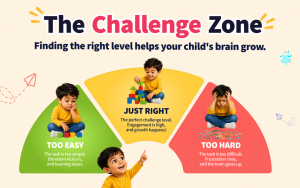
And lastly, is your child a little challenged, but not so frustrated they want to quit. That “just right” difficulty zone is where the most learning tends to happen. If it’s too easy the brain kind of coasts. If it’s too hard the child shuts down.
The Part Parents Usually Get Wrong
Here’s an uncomfortable truth: a lot of parents unintentionally take over the game. Your toddler is stacking blocks and you jump in to “help” by stacking them the right way, or you correct the color sorting because the yellow one’s in the wrong pile. It feels helpful. It’s usually not. Kids build the most brain connections when they’re the ones solving the problem, even if they solve it wrong three times before getting it right. Watching you do it perfectly teaches them a lot less than fumbling through it themselves. This is genuinely hard for a lot of parents to sit with — but the fumbling is the point. The other common mistake is over-scheduling. Structured activities have their place, but toddlers also need long stretches of unstructured, boring-looking time to just mess around with toys on their own terms. Some of the richest brain development happens in those unscripted fifteen minutes when nobody’s directing anything.
You Don’t Need to Buy Anything
It’s worth saying plainly: none of this requires expensive toys. A cardboard box, a pile of laundry, some measuring cups in the bathtub — these do just as much for a developing brain as anything with a brand name and a $40 price tag. What matters is the interaction, not the object. A parent playing peekaboo with a dish towel is doing more for brain development than an app running on autopilot in the background. If anything, simple, open-ended objects tend to work better than toys that only do one thing. A toy that lights up and plays a song when you press a button gives the child one path. A wooden spoon and a pot give them infinite paths.
Now here’s the thing, games are only one piece of it. Two other things end up mattering just as much, honestly maybe more, once your kid gets a little older, and they kind of work alongside all this play stuff instead of separate from it.
Child Character Traits Development
Okay so, character. This one’s trickier because you can’t really see it building the way you can watch a block tower go up. But it’s happening, in like, the tiniest moments, way more than in some big sit-down talk about “being kind.”
Child character traits development works a lot like the game stuff above, actually — repetition, not lessons. A three year old doesn’t get patient because you explained patience to her one time. She gets patient because she practiced waiting, forty different times, forty different moods about it, and slowly the muscle just… forms.
This is really the whole engine behind child character traits development — small reps, not speeches. A few traits do most of the heavy lifting early on. Empathy shows up way earlier than people think, even two year olds will pat a crying friend or hand over their own toy, no one told them to. Patience is the hard one, mostly because the impulse control part of the brain is one of the last bits to actually finish growing, sometimes not till the mid twenties honestly, so expecting a toddler to just “be patient” is kind of asking a lot. Honesty grows out of trust, not punishment — kids who can admit a mistake without getting yelled at tend to stay honest longer, weirdly. Resilience is basically the tower thing again, fall down, rebuild, fall down, rebuild. And kindness, that one mostly starts as copying, before it’s ever real, and that’s fine, it still counts.
There’s this idea some people call character vaccination, small repeated doses of a good value build up real strength over time, kind of like how a vaccine works. One kind moment doesn’t make a kind kid. It’s the pattern that does it, held over weeks and months, not any single perfect parenting moment.
What actually helps, day to day: say your own feelings out loud (“I’m frustrated, so I’m gonna take a breath”), let natural consequences happen when it’s safe to, praise the effort and not just the outcome, and give real chances to practice the trait instead of just telling them to do it. Kids absorb way more from watching you handle a hard moment than from being told how to handle theirs.
Kids Daily Routine and Discipline
And then there’s the routine piece, which kind of holds the other two together, honestly. A steady kids daily routine and discipline structure gives a toddler something they can’t build for themselves yet, predictability, in a world that otherwise feels random and a little too big for them.
Toddlers do better when they know what’s coming next. It’s part of why the same bedtime story every single night feels calming instead of boring to them. Predictability just… lowers the anxiety a bit. One less thing to fight against.
You don’t need a fancy schedule. Most toddlers do fine with some version of: consistent wake time, similar order to meals and activities, a wind down before naps and bedtime, and clear little cues before transitions, like “five more minutes then we clean up.” The exact schedule matters way less than just, keeping the pattern the same.
This is the “discipline” half of kids daily routine and discipline, and it slots into the same idea — it works best as teaching, not punishing. Set the expectation before the moment happens, not during it, a kid told the plan ahead of time handles it better than one who’s surprised by it. Keep consequences related and quick, if a toy gets thrown, the toy takes a break, kids connect that dot fast when the timing lines up. Stay calm even when they’re not, a meltdown mid-storm can’t absorb a lecture, what helps is just, steady presence, then talking once it’s calm again. And be consistent across days more than perfect on any one day, toddlers test boundaries because that’s literally how they figure out where the edges are, not because they’re being difficult on purpose.
The Bottom Line
Play isn’t the fluffy part of childhood you squeeze in around the “real” learning. For a toddler, play is the real learning. Every stacked block, every sorted button, every round of peekaboo is quietly wiring a brain that’s working harder right now than it ever will again. And it’s not really separate from the character stuff or the routine stuff either, honestly, it’s all kind of the same project.
You don’t need a plan. You need fifteen unhurried minutes, a few household objects, some steady daily rhythm your kid can count on, and the willingness to let your kid mess it up a few times before they figure it out. That’s the whole game — and it’s still one of the most effective brain development games for toddlers you’ll ever find, free of charge, on your living room floor.