
 by development.emi
 No Comments

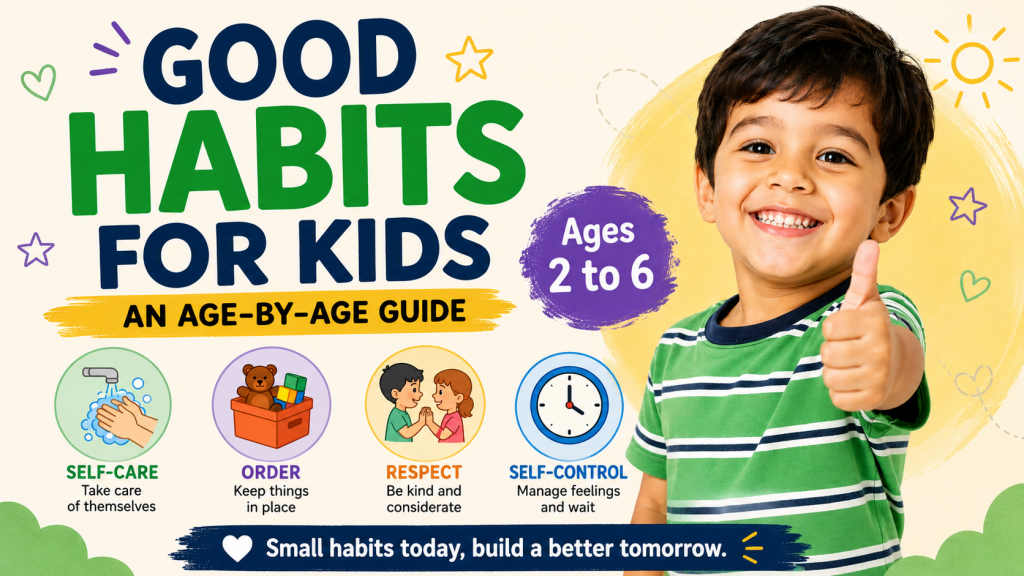
Good Habits for Kids: An Age-by-Age Guide for Ages 2 to 6
Good habits for kids are small actions a child repeats until nobody has to ask any more — washing hands before eating, putting shoes on the rack, waiting for a turn. They form fastest between ages two and six, because at that age the routine around a child is still yours to set. Teach one habit at a time, attach it to something that already happens daily, and expect about two months.
What are good habits for kids?
A good habit is a behaviour a child performs without being asked. That is what separates it from obedience — obedience needs an adult in the room, a habit does not. In children aged two to six, almost every habit worth building falls into four groups, and they mature at different speeds.
- Self-care — handwashing, brushing, eating without a screen. Realistic from age 2.
- Order — shoes on the rack, one toy back in the box, plate to the sink. From about 2.5.
- Respect — greeting elders, saying thank you, not interrupting. From about 3.
- Self-control — waiting for a turn, stopping before hitting, accepting “no”. From about 4.
Self-control is last for a reason. It is the slowest to develop and the one most worth the effort. In a study that followed a thousand children from birth to age 32, those with the weakest self-control in their early years had higher rates of substance dependence, criminal conviction and poor health as adults, even after accounting for social class and IQ.1
At what age should you start teaching good habits?
Start at two. A two-year-old cannot follow a rule but can repeat an action, so habit teaching at this age is physical rather than verbal — you guide the hands and keep the sequence identical every day. Reasons and explanations only start earning their keep closer to four.
It is not that a seven-year-old cannot learn a new habit. It is that before six you control almost every input: when the child eats, sleeps, plays and who they spend the day with. Once school and friendships arrive you are one influence among several, and the same habit costs more to install.
Good habits for kids, age by age
The teaching method changes far more between two and six than the habit list does. Treat the ages as a rough order of operations, not a scorecard.
Ages 2 to 3
- Washes hands before eating, with your hands over theirs at the tap
- Puts one toy back before the next one comes out — one, not the room
- Says thank you when handed something, prompted every time
- Comes when called, once
- Sits down to eat for one small meal, no screen on the table
How to teach at this age: physically and identically. Say the same four words each time and do the action with them. Do not explain why — you will lose them by the second sentence.
Ages 3 to 4
- Shoes on the rack on the way in, before anything else
- Tidies one area before moving to the next activity
- Waits for a turn for about thirty seconds
- Says sorry when prompted — meaning it comes later, the habit comes first
- Carries their plate to the sink after eating
How to teach at this age: warn before every transition — “two more turns, then shoes.” Use “first this, then that” rather than “if you don’t, then.” Most three-year-old meltdowns are transition failures, not habit failures.
Ages 4 to 5
- Packs their own bag against a picture checklist
- Waits to speak while an adult is mid-sentence
- Shares when no adult is watching — the real test of the habit
- Asks before taking something that is not theirs
- Says sorry unprompted, and can say what the sorry is for
How to teach at this age: give a one-line reason, then step back and let them do it badly. Four-year-olds who are corrected mid-task stop initiating. A shoe on the wrong foot they put there themselves beats a shoe you fixed.
Ages 5 to 6
- Runs the morning routine — brush, dress, bag — mostly unprompted
- Owns one daily job nobody else does: watering a plant, laying the table
- Stays with a hard task for a minute before asking for help
- Admits a mistake without being caught first
- Accepts a “no” without negotiating it into a twenty-minute event
How to teach at this age: let small consequences land. The plant that droops because it was not watered teaches more in a week than six months of reminders.
How many days does it take a child to form a habit?
Not 21. That number comes from a 1960 plastic surgeon’s observation about patients adjusting to a changed appearance — it was never habit research. The one careful study of habit formation found a median of 66 days, ranging from 18 to 254. Plan for about two months of daily repetition.2
For a young child, one thing matters more than the day count: whether the routine around the habit stayed the same. Sixty days of inconsistent practice is not sixty days of practice — it is sixty separate first attempts.
How to teach a good habit to a child
Pick one habit, attach it to something that already happens daily, and keep the routine identical for about two months before adding anything new. These eight steps are the whole method.
- Pick one habit. Only one. Every extra habit you start at the same time roughly halves the odds on all of them.
- Attach it to something that already happens. After we come through the door, shoes go on the rack. The existing routine carries the new habit.
- Make the first version almost too easy. One toy back, not the whole room. You are building the reflex first; size comes later.
- Do it with them for the first two weeks. Alongside, not supervising from the doorway. Children this age learn sequences by copying them.
- Name the behaviour, not the child. “You put your shoes away without me asking” beats “good boy.” It tells them what to repeat.
- Expect the dip in week two. The novelty is gone and the automatic response has not formed yet. Most parents quit here.
- Keep the routine identical for two months. Same time, same order, same words, same response from every adult in the house.
- Add the next habit only when the first runs unprompted. The test is whether they do it when you have said nothing.
Why good habits break down
When a habit that was working stops working, it is usually one of these five.
- Adults are inconsistent. The habit holds with one person and vanishes with another. This is the most common cause by a distance — a child who gets the phone at lunch from one adult and not another has not learned “no phone at meals”, they have learned to wait for the right adult.
- Rewards have inflated. What worked as praise now needs a chocolate. Move from things to noticing.
- Tired, hungry or over-stimulated. If it fails at predictable times, it is a scheduling problem, not a discipline one.
- Too many habits at once. Drop back to one. The others get easier afterwards, not harder.
- Attention only arrives on failure. Notice the habit out loud when it goes right, or failing becomes the more reliable way to be seen.
If grandparents or a helper share the day, do not open a debate about parenting. Pick the one habit you are working on this month and get everyone to agree on that single rule, in one sentence. One rule at a time is a request people will actually say yes to.
Common questions
Should I reward good habits with sweets or screen time?
Use them sparingly and plan how to stop. Material rewards work quickly and then inflate. Screen time is the worst choice, because it raises the value of the screen at exactly the age you want to lower it.
My child behaves well at school but not at home. Why?
Very common, and usually a good sign. School has one consistent rule set and no emotional safety net, so children hold themselves together there and release at home. If the habits exist at school, the capacity exists — look at consistency of the rule at home first.
How do I get grandparents to follow the same rules?
Ask for one rule, not a philosophy. State it in one sentence, explain what you are building, and ask for help on that one thing for a few weeks. Broad requests to “be stricter” get resisted; specific ones do not.
Is it too late if my child is already six?
No. The two-to-six window is easier, not exclusive. After six the same eight steps work — expect them to take longer and to need the child’s agreement rather than just your routine.
Where Todemy fits
Everything above can be done with a chart and consistency. What most parents run out of is not willingness — it is the daily material: what to do today, in what order, for this age.
Todemy is a behavioural development programme for children aged 2 to 6, built over two years with child psychologists. It runs the same habit through five channels in a day — a video, an audio book, a conversation with Uncle Boopi, one offline activity done away from the screen, and a meal plan — because some children learn a habit from a story and some only after they have done it themselves. It takes 45 minutes split across the day, never one long sitting, and the audio books and offline activity need no screen at all.
Answer six questions to see where Todemy would start with your child, before you pay anything. If you want the values half of this, read our guide to moral values for kids.
Todemy is an educational programme, not therapy and not a diagnosis. If you have concerns about your child’s development, speak to your paediatrician.